
Views: 0 Author: Site Editor Publish Time: 2025-12-24 Origin: Site


The global packaging industry is currently navigating a significant migration from traditional cored rolls to "paperless" solutions. This shift is driven by aggressive Environmental, Social, and Governance (ESG) goals and an urgent need to cut operational costs in a tightening economy. For converters and manufacturers, sustainability is no longer just a marketing buzzword; it has become a critical manufacturing mandate. However, transitioning to this leaner production model presents unique engineering hurdles. Producing high-quality coreless film requires precise tension control and specialized winding technology, distinct from standard converting processes.
If the tension is too loose, the roll collapses; too tight, and the layers fuse. This article evaluates fully automatic coreless stretch film rewinders for manufacturers looking to upgrade their production lines. By understanding the machinery that enables this shift, you can improve unit margins, optimize logistics for your clients, and meet the rising demand for zero-waste packaging.
Cost Efficiency: Coreless production eliminates purchasing cardboard cores (approx. $1/roll savings) and reduces shipping weight.
Technology Types: Understanding the difference between surface friction winding and mandrel extraction methods is critical for film quality.
Operational ROI: Fully automatic rewinders minimize labor costs and eliminate the "changeover downtime" associated with reloading paper cores.
Market Viability: Coreless film is preferred for cleanrooms and heavy-volume logistics due to zero disposal waste and optimized storage density.
The decision to invest in coreless technology often starts with the bottom line. While the environmental narrative is compelling to end-users, the manufacturing logic rests on direct material savings and supply chain density.
The most immediate financial impact comes from the removal of the cardboard core. Industry data suggests that the raw material cost for a standard paper core hovers around $1 per roll, depending on wall thickness and market pulp prices. For a facility producing thousands of rolls daily, this represents a massive recurring expense. By switching to coreless production, you essentially transfer that dollar straight to your margin or use it to price your product more aggressively.
Beyond the direct purchase cost, consider the inventory management aspect. Paper cores are bulky. They require significant warehousing space, climate control to prevent humidity absorption (which weakens the core), and manual labor to move from delivery docks to the production floor. Eliminating this inventory frees up valuable square footage for finished goods or additional production lines.
Logistics efficiency drives the adoption of coreless film among heavy-volume users. The mantra here is simple: "Ship film, not air and cardboard." Standard rolls contain dead volume in the center and dead weight from the heavy paper tube. Coreless rolls are dense, allowing for tighter pallet configurations.
Factory safety managers are increasingly advocating for coreless solutions. In a busy warehouse, discarded paper cores are a primary tripping hazard. They roll easily, clutter packing stations, and create debris. Furthermore, paper dust accumulates over time, creating fire risks and respiratory irritants.
In specialized sectors like pharmaceuticals and electronics manufacturing, coreless film is becoming the standard. These industries operate cleanrooms where paper dust is a contamination risk. By offering a product that generates zero waste and introduces no foreign particulates, manufacturers can access premium, high-margin markets that traditional converters cannot serve.
Producing a stable roll of plastic without a rigid center support is an engineering challenge. Without a core, the film must support itself. If the internal tension is incorrect, the roll faces two failure modes: "implosion" (where the center collapses) or "telescoping" (where the layers slide out like a telescope). Understanding the two primary winding technologies is essential for selecting the right equipment.
Surface winding relies on the friction between the film roll and a driven drum. As the film winds, the growing roll rests against a roller that controls the density of the pack. This mechanism is simpler and generally less expensive to implement.
The primary advantage is mechanical simplicity. However, the risk lies in heat and pressure. If the friction is too high, the layers of thin stretch film can fuse together, making the roll impossible for the end-user to unwind. This method requires operators to find a delicate balance where the roll is tight enough to hold its shape but loose enough to dispense freely.
High-speed, professional-grade production typically utilizes mandrel extraction systems. In this process, the machine winds the film onto a specialized steel mandrel—effectively a temporary core. Once the winding cycle is complete, the machine automatically extracts the mandrel, leaving a perfectly formed hollow center.
When evaluating a machine, pay close attention to the mandrel technology. Advanced systems use patented non-stick coatings or air-assist technologies. Air-assist systems pump a burst of air between the mandrel and the film layer just before extraction. This breaks the vacuum seal and allows the mandrel to slide out without distorting the inner layers of the film. This feature is critical for maintaining the structural integrity of the roll during the extraction phase.
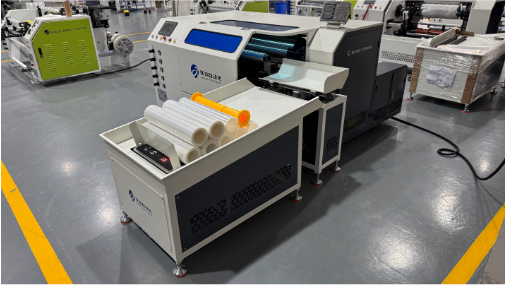
When you are ready to source equipment, the specifications sheet can be overwhelming. To ensure you select a machine that delivers operational ROI, focus on these critical criteria.
True automation in coreless rewinding looks different than in standard rewinding. Since there are no cores to load, verify that the "core feeding" step is completely eliminated from the cycle time. The machine should transition seamlessly from winding to cutting to ejection.
Assess the speed of the auto-cut and transfer cycle. In high-volume production, seconds matter. A slow transfer creates a long "tail" on the finished roll, which looks unprofessional and can interfere with packaging. High-speed rewinders utilize flying knifes or hot wire systems to ensure a clean cut and an immediate start to the next cycle without operator intervention.
Tension control is the heartbeat of coreless production. Standard rolls rely on the cardboard core to define the shape; coreless rolls rely entirely on internal tension. If the tension is constant throughout the winding process, the inner layers may be crushed by the pressure of the outer layers (star-spoking).
You must ask the manufacturer about their tension profiling capabilities. Look for closed-loop tension control systems (using load cells) that allow for "tapered tension." This feature gradually reduces the winding tension as the roll diameter increases, preventing the crushing of the inner diameter and ensuring the roll remains stable during shipping.
For co-packers serving diverse clients, dedication to a single format can be risky. A competent stretch film coreless rewinding machine manufacturer will often offer hybrid units. These machines can switch between coreless winding and thin-core winding with minimal changeover time.
This flexibility allows you to serve legacy clients who still demand paper cores while transitioning other accounts to coreless solutions. It acts as a bridge, ensuring your capital equipment remains utilized regardless of momentary market shifts.
Finally, inspect the quality of the finished roll. Does the machine support standard 2-inch or 3-inch equivalent inner diameters? This ensures compatibility with your customers' existing dispensers.
Crucially, look for "folded edge" capabilities. Coreless rolls are susceptible to edge damage; if a roll is dropped, the edge can dent, causing the film to tear during unwinding. Oscillating rollers that create a folded or reinforced edge add structural rigidity to the roll faces, significantly reducing waste due to drop damage. This is a hallmark of high-end machinery.
To justify the investment in new machinery, you need to calculate the Total Cost of Ownership (TCO) and Return on Investment (ROI). The following breakdown highlights where the savings accumulate.
The math for material savings is straightforward but powerful. You can estimate your annual savings using this basic formula:
(Cost of Core × Rolls Produced per Year) + (Core Disposal Fees saved by customer) = Total Direct Savings
If you produce 500,000 rolls annually and a core costs $0.80, that is $400,000 in immediate raw material savings. Even if the coreless machine carries a premium, the payback period is often less than 12 months based on material elimination alone.
| Cost Driver | Standard Rewinding (Manual/Semi-Auto) | Fully Automatic Coreless Rewinding |
|---|---|---|
| Core Material | High Recurring Cost | $0.00 |
| Labor Input | High (Loading hoppers, managing inventory) | Low (Monitoring parameters only) |
| Shipping Density | Standard (Includes air/paper weight) | High (+10-20% product per truck) |
| Waste Disposal | Customer pays to trash cores | Zero waste product |
Labor reduction is another significant driver. Comparing semi-automatic machines to fully automatic units reveals hidden costs. Semi-auto units require operators to manually load cores onto mandrels. A fully automatic system removes this step entirely. Operators shift from manual laborers to machine supervisors, allowing one employee to oversee multiple lines simultaneously.
Investors and large corporate buyers are increasingly scrutinizing Scope 3 emissions. By adopting coreless technology, you help your customers reduce their carbon footprint. You are framing the investment not just as a machine purchase, but as a sustainability compliance move. This positions your company as a strategic partner rather than a commodity vendor.
Transitioning to coreless production is profitable, but it is not without operational nuances. Being aware of these risks ensures a smoother deployment.
The most common defect in coreless manufacturing is the "crushed roll," where the roll deforms into an oval shape during storage. This usually happens if the winding tension is too loose or if rolls are stacked too high on a pallet.
The solution lies in correct packing configurations and machine settings. You must dial in the specific hardness settings on the rewinder to match the film's thickness. Additionally, using "interlocking" stacking patterns or protective layer pads on pallets can distribute weight evenly and prevent deformation.
You must verify how the end-user applies the film. Coreless film holds a 90% dominance in hand wrap applications, but machine wrap scenarios require adapters. If your client uses automated pallet wrappers, they will need a mandrel adapter to hold the coreless roll.
For hand wrapping, the "ergonomics" complaint is a common adoption barrier. Friction from the spinning roll can burn an operator's hands. Ensure the coreless rewinder for the stretch film produces rolls compatible with standard reusable plastic handles or inserts. Providing these reusable dispensers alongside the film solves the ergonomic issue and facilitates the switch.
Finally, prepare your workforce. The skill set required shifts from managing consumables (loading cores) to managing machine parameters. Operators need training on how tension, speed, and contact pressure interact. They must learn to recognize the signs of "telescoping" early and adjust the tapered tension profile accordingly.
Moving to fully automatic coreless rewinding is a strategic margin-expansion strategy that aligns perfectly with global sustainability trends. By eliminating the cost and waste of paper cores, manufacturers can offer a competitively priced, eco-friendly product that appeals to modern logistics and cleanroom standards.
The ideal machine combines high-speed automation with precise, closed-loop tension control to produce stable, shippable rolls. It transforms the production floor from a material-heavy operation into a lean, efficient environment. We encourage production managers to audit their current core costs and request sample coreless rolls or schedule a demo of the rewinding technology to see the stability and quality firsthand.
A: Yes, many advanced manufacturers offer hybrid machines. These units utilize exchangeable shafts or adaptable mandrels that allow operators to switch between coreless production and standard thin-core rewinding, providing flexibility for diverse customer bases.
A: For manual application, operators typically use reusable plastic handles that insert into the roll's hollow center to prevent friction burns. For machine applications, simple adapters are required to fit the coreless roll onto standard carriage mandrels.
A: While machines can wind large diameters, the practical limit is often determined by the roll's structural stability. Very large diameter coreless rolls risk deformation. Standard finished diameters typically mimic equivalent 1,000ft or 1,500ft hand rolls.
A: The primary material saving is the cardboard core (100% elimination). However, plastic volume is often optimized because coreless technology is frequently paired with capabilities, which can reduce plastic usage by 30-50% per load wrapped.


