
Views: 0 Author: Site Editor Publish Time: 2026-04-29 Origin: Site


Understanding the stretch film rewinder and slitter use is essential for manufacturers seeking to optimize their packaging operations. Guangdong Juexuan Automation Equipment Co., Ltd. provides intelligent machines that transform large film rolls into precise, uniform rolls for diverse applications. These machines improve workflow efficiency, reduce material waste, and enhance operational productivity. By combining advanced tension control, adjustable slitting blades, automated winding systems, and real-time monitoring, Juexuan Automation ensures consistent, high-quality results for PE film, plastic film, and other flexible packaging materials.
Proper setup is the first critical step in using a stretch film rewinder and slitter effectively. Operators must begin by preparing the jumbo rolls, ensuring that core diameters are suitable for the intended output. The correct core size is crucial for maintaining proper tension during the slitting and rewinding process, preventing material slippage and uneven roll formation.
Once the jumbo rolls are positioned, operators need to adjust the slitting blade widths to achieve the desired roll size. Blade alignment and sharpness are essential, as misaligned or dull blades can cause uneven cuts, waste material, and reduce operational efficiency.
Tension settings are then configured according to the type of film being processed. Different materials require different levels of tension; for example, thinner PE films are more sensitive to over-tensioning, while thicker plastic films may require slightly higher tension to maintain compact, uniform rolls. A proper test run at this stage helps to identify potential issues, ensuring that the machine produces consistent rolls throughout the production batch.
Operators should also check feed rollers, alignment guides, and winding shafts. Any misalignment can result in wrinkles, uneven rolls, or film tearing. Advanced Juexuan Automation systems provide touch-screen interfaces and real-time monitoring to facilitate these adjustments, allowing operators to calibrate settings quickly and accurately.
After setup, the actual rewinding and slitting process begins. The workflow typically follows a sequence: unwinding → slitting → winding. Jumbo rolls are first unwound steadily under controlled tension, then passed through the slitting section where blades cut the film into the specified widths, and finally rewound onto output shafts to produce finished rolls.
During operation, continuous monitoring of speed, alignment, and tension is essential. Operators can observe machine indicators to detect any deviation in roll tightness, uneven cutting, or blade performance. Real-time feedback allows for immediate adjustments to prevent defective rolls, minimize waste, and maintain production quality.
It is important to note that different film types and thicknesses require different machine settings. PE films, commonly used in food packaging, require delicate handling to avoid tearing, whereas industrial plastic films may need higher winding torque. By adjusting parameters in real-time, manufacturers can ensure high-quality output across a variety of materials and applications.
Many advanced machines can slit and rewind multiple rolls simultaneously, increasing production efficiency. Operators must ensure that each roll maintains proper tension and alignment to prevent cross-wrapping or uneven roll formation.
Multi-roll operations are particularly valuable in high-volume logistics, retail, and manufacturing lines where time efficiency and consistent roll quality are crucial. With careful monitoring and proper calibration, operators can produce dozens of uniform rolls from a single jumbo film, reducing downtime and enhancing overall productivity.
Film wrinkles and air bubbles can compromise both roll quality and downstream packaging operations. Maintaining proper tension throughout the slitting and rewinding process is key. Automated tension control systems adjust dynamically to accommodate variations in roll diameter and film thickness, ensuring a smooth surface and uniform roll.
Blade sharpness and cleanliness also play a significant role. Dull or contaminated blades increase friction, leading to wrinkles or torn edges. Operators should clean blades regularly and check alignment before every production run.
Additionally, feed rollers and guide systems should be inspected to prevent uneven tension distribution, which can create air bubbles or misaligned rolls. Implementing these practices ensures a smooth, professional-quality roll ready for immediate packaging use.
Efficient operation depends on synchronizing blade speed and winding tension. The blades must cut precisely without stretching or tearing the film, while the winding shafts maintain uniform tension to produce compact rolls.
Juexuan Automation machines allow independent adjustment of blade speed, winding torque, and feed rate. For example, thin PE films require slower blade speeds and precise tension adjustments, whereas thicker plastic films benefit from higher winding torque to maintain compactness. Proper synchronization prevents defects and increases overall throughput while minimizing material waste.
High-volume production lines benefit from setting up machines to run continuously with minimal interruptions. Operators should plan roll widths and diameters in advance, aligning them with downstream packaging needs. Smaller hand rolls are ideal for manual wrapping, while larger rolls feed automated pallet wrapping systems.
Implementing batch planning and regular quality checks during operation ensures consistent production without stoppages. Operators can also monitor key performance indicators such as roll density, blade sharpness, and film tension to maintain peak efficiency.
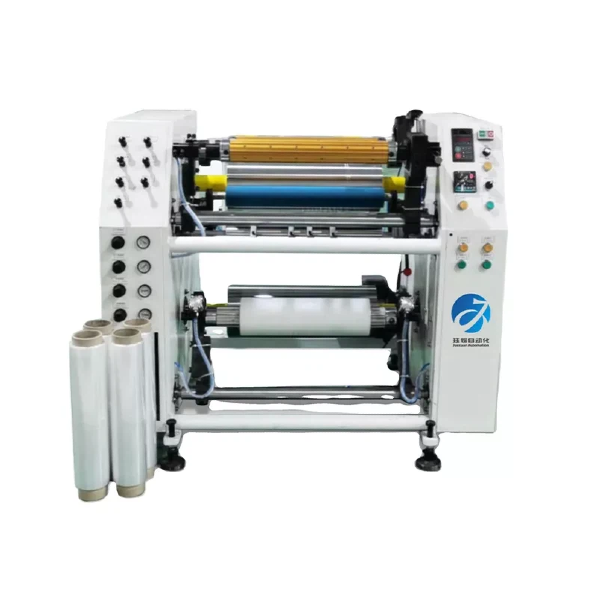
Slitting blades are extremely sharp and require careful handling. Operators must wear protective gloves, follow safety protocols, and never bypass safety interlocks. Juexuan Automation machines are equipped with guards and emergency stops to prevent accidents, but operator vigilance is critical for safe operation.
Proper maintenance ensures long-term reliability. Lubrication of moving parts reduces wear and prevents unexpected machine stoppages. Regular cleaning of blades, rollers, and tension guides prevents debris buildup that could interfere with slitting quality.
Operators should regularly inspect the machine for unusual vibration, noise, or irregular movement. Early detection of potential mechanical issues prevents downtime and ensures that rolls meet quality standards. Scheduled preventive maintenance, combined with automated alerts on Juexuan Automation machines, allows for proactive management of equipment health.
Challenge | Likely Cause | Suggested Fix |
Film wrinkling | Poor tension | Adjust tension system |
Uneven roll width | Blade misalignment | Re-calibrate slitting blades |
Slow output | Incorrect cutting speed | Optimize speed settings |
Material slippage | Wrong core diameter | Ensure proper core installation |
Film tearing | Excessive tension | Reduce winding tension |
This table provides practical guidance for operators to troubleshoot common issues efficiently, ensuring high-quality output.
Even with automation, operators should periodically inspect roll formation for uniformity, tightness, and smoothness. Any deviation can be corrected immediately to prevent waste and maintain consistent production quality.
Proper handling of jumbo rolls and finished rolls prevents damage and preserves film quality. Using correct lifting equipment and storage methods reduces the risk of crushing or deforming rolls, ensuring they remain ready for packaging.
Standardizing machine settings for repeatable roll sizes improves efficiency across production lines. Recording successful configurations for different film types allows operators to switch quickly between batches, reducing downtime and improving overall throughput.
PE film rewinding ensures safe, hygienic rolls suitable for food products. Consistent tension and width prevent film tearing and contamination, supporting regulatory compliance.
Mini roll slitting provides uniform consumer-ready packaging for retail and e-commerce. Standardized rolls improve efficiency for store operations and shipping.
Bunding stretch film slitting allows multiple products to be secured together efficiently. Uniform rolls prevent breakage and ensure stable bundles for transport.
Precision narrow slitting protects sensitive components during storage and shipment. Uniform rolls reduce handling issues and maintain product integrity.
Slitting film before printing improves print quality by ensuring smooth, even surfaces. This reduces errors and increases throughput in labeling and packaging operations.
Mastering stretch film rewinder and slitter use ensures efficient, precise, and consistent film conversion, enhancing productivity across industries. Guangdong Juexuan Automation Equipment Co.,Ltd. offers intelligent machines that streamline PE film, plastic film, and specialty film operations. These systems reduce waste, increase throughput, and maintain high-quality output. For manufacturers aiming to optimize packaging workflows, contact us today to experience the advantages of an automatic stretch film slitting machine.
Q1: What is the first step in using a stretch film rewinder and slitter?
A1: Preparing jumbo rolls, selecting correct core diameters, and adjusting blade width and tension are essential before operation.
Q2: How can film wrinkles be prevented during use?
A2: Proper tension, aligned blades, and smooth feeding prevent wrinkles and bubbles, ensuring consistent rolls.
Q3: Can this machine handle different film types?
A3: Yes, Juexuan Automation machines process PE film, plastic film, and other flexible materials efficiently.
Q4: How does proper maintenance affect machine performance?
A4: Routine lubrication, cleaning, blade inspection, and preventive maintenance ensure consistent output and extend machine lifespan.


