
Views: 0 Author: Site Editor Publish Time: 2026-05-01 Origin: Site


Understanding the stretch film rewinder and slitter type is critical for manufacturers who want to optimize production efficiency, maintain consistent roll quality, and reduce material waste. Guangdong Juexuan Automation Equipment Co., Ltd. offers an extensive range of machines designed to meet different production needs—from small workshops requiring semi-automatic systems to large-scale facilities that depend on fully automatic, high-throughput operations. Selecting the appropriate machine type ensures that businesses can handle PE film, plastic film, and specialty films efficiently while maintaining operational consistency and minimizing downtime.
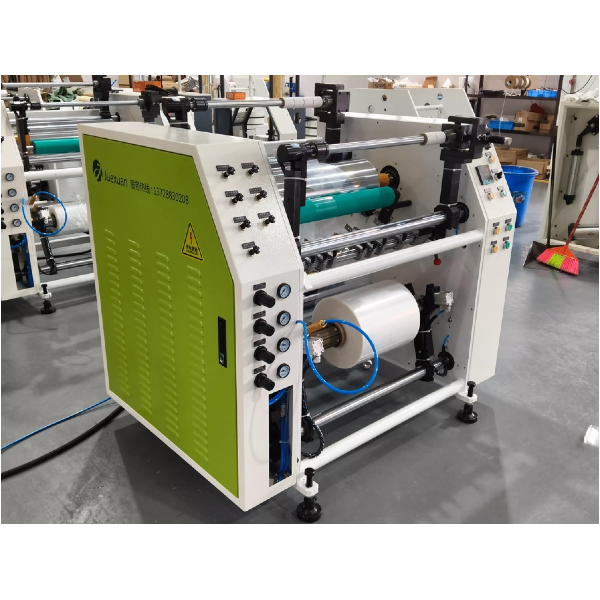
Stretch film rewinders and slitters are primarily categorized by automation level: semi-automatic and fully automatic machines. Semi-automatic models are best suited for small-scale or medium-volume production. Operators manually load and replace cores, but the machine automates slitting and rewinding processes to maintain uniform roll widths and tight winding. These machines are flexible, cost-effective, and ideal for workshops producing specialty packaging, custom roll sizes, or batches with varied dimensions.
Fully automatic machines are engineered for continuous, high-volume production. They include automatic core loading and unloading, real-time tension monitoring, synchronized slitting and winding, and intelligent PLC controls. These machines minimize human intervention while ensuring precise, consistent output. Fully automatic units are particularly valuable for large-scale operations, such as logistics hubs, food packaging lines, and retail fulfillment centers, where speed, consistency, and minimal downtime are essential.
In addition to automation, considerations such as roll diameter capacity, maximum film width, and speed adjustability differentiate these machines. Semi-automatic models often serve niche applications where flexibility and lower investment are priorities, while fully automatic machines deliver scalability and high throughput for industrial-scale operations.
Rewinding configuration is another classification criterion. Single-shaft machines produce uniform roll widths and are easy to operate, making them suitable for standard production lines. Multi-shaft machines, in contrast, can produce several rolls simultaneously from a single jumbo roll, supporting diverse roll widths and lengths.
Multi-shaft machines are highly efficient for operations that require mixed-width rolls, such as logistics centers serving both pallet wrapping and retail packaging. By producing multiple rolls in one run, manufacturers reduce downtime and labor costs while optimizing material usage. Single-shaft machines remain popular in small to medium-scale operations due to their simplicity, reliability, and ease of maintenance.
Semi-automatic machines are ideal for low- to medium-volume production. They require manual core changes but automate the slitting and rewinding processes. Operators can adjust blade spacing and winding tension according to film type and output requirements, producing uniform rolls with minimal waste.
These machines handle PE films, plastic films, and specialty films, making them suitable for various applications, including food packaging, retail products, and industrial bundling. Semi-automatic models provide a balance between cost and functionality, allowing small manufacturers to achieve consistent roll quality without investing in high-end automation.
A typical workflow includes manual core loading, adjusting blade positions, setting winding tension, and starting the automated slitting and rewinding process. Operators monitor the machine for alignment and tension consistency, ensuring smooth operation and high-quality output. Semi-automatic models often feature safety interlocks, adjustable speed settings, and tension controls to maintain reliability across multiple production runs.
Fully automatic stretch film rewinders and slitters are designed for large-scale, high-speed production. Key features include auto core insertion, automatic roll unloading, and synchronized blade and winding control. PLC touch-screen interfaces allow operators to set parameters for different films, roll widths, and diameters.
These machines maintain precise tension and alignment throughout the process, preventing wrinkles, uneven edges, or roll deformation. High-speed operation ensures that large orders are fulfilled efficiently, reducing downtime and increasing productivity. Fully automatic machines are also ideal for facilities that handle multiple film types or require rapid format changes.
By incorporating intelligent error detection, fully automatic machines can identify misalignment, tension issues, or blade wear and notify operators for immediate adjustment. This level of automation minimizes waste, improves output quality, and allows production lines to operate continuously with minimal supervision.
Specialty models include coreless rewinders and high-speed slitting machines. Coreless rewinders eliminate the need for a central core, improving material utilization and reducing waste. They are ideal for high-volume applications in industrial packaging, electronics, and automotive components.
High-speed slitting machines are engineered for operations requiring rapid output without sacrificing quality. Reinforced blades, high-torque motors, and advanced tension control ensure smooth operation and consistent roll density even at elevated speeds.
Other specialty configurations may combine multi-shaft rewinding with automatic core loading, enabling simultaneous production of multiple roll sizes in high-throughput lines. These machines are perfect for mixed-production environments that require versatility and efficiency without stopping production for roll changes.
Machine Type | Automation Level | Typical Output | Best For | Key Benefits |
Semi-Auto | Low | Medium | Small workshops | Cost-effective, flexible, precise for low-volume runs |
Auto | High | High | Large production lines | Continuous operation, minimal labor, high throughput |
Multi-Shaft | Medium | Variable | Mixed roll sizes | Multiple widths, efficient, reduces downtime |
Coreless | High | Consistent tension | Zero-core film | Reduces waste, consistent roll quality, high-speed capability |
This table provides a comprehensive overview for manufacturers, assisting in selecting the right machine based on production scale, roll diversity, and material type.
Advanced PLC systems allow operators to manage slitting speed, blade positioning, and winding tension with precision. Real-time monitoring ensures that rolls remain uniform and detect any deviations promptly.
Automated tension systems maintain consistent roll density, preventing wrinkles, stretching, or uneven winding. Dynamic adjustments adapt to variations in roll diameter and film thickness, ensuring high-quality output across different production lines.
Intelligent feedback systems detect misalignment, tension anomalies, or blade wear and alert operators immediately. This prevents material waste, reduces downtime, and ensures continuous high-quality production.
Machines with multi-shaft capability can simultaneously wind several rolls from one jumbo roll. Automated core handling ensures rolls are tightly wound and aligned, improving efficiency for mixed-production environments.
Semi-automatic machines allow small manufacturers to produce uniform rolls efficiently. They are ideal for businesses producing specialty packaging, custom roll sizes, or moderate-volume batches.
Fully automatic machines provide high throughput and reliability for large-scale facilities, such as logistics hubs, retail packaging centers, and industrial plants. Automation minimizes operator intervention while maintaining consistent output.
Multi-shaft machines are perfect for operations requiring different roll widths simultaneously. Logistics centers or warehouses benefit from producing both pallet-sized and retail-sized rolls in one operation.
Coreless rewinders reduce material waste and provide uniform tension for industrial applications, including electronics, automotive parts, and protective films. They support high-speed operations while maintaining roll integrity.
High-speed slitting machines support applications where rapid production and precise roll dimensions are critical, such as shrink film production, food packaging, and protective overlays for electronics.
Choosing the right stretch film rewinder and slitter type is essential for optimizing production efficiency, maintaining consistent roll quality, and reducing material waste. Guangdong Juexuan Automation Equipment Co.,Ltd. offers semi-automatic, fully automatic, multi-shaft, and coreless machines, each tailored to specific production needs. To explore our machines and request detailed information, contact us today and experience the efficiency of an automatic stretch film rewinder that meets your operational requirements.
Q1: What is the difference between semi-automatic and fully automatic machines?
A1: Semi-automatic machines require manual core changes and are ideal for low-volume operations. Fully automatic machines feature auto-loading, auto-unloading, and high-speed continuous operation for large-scale production.
Q2: How do multi-shaft machines enhance efficiency?
A2: Multi-shaft machines can produce multiple roll widths simultaneously, reducing downtime and increasing output versatility for mixed-production lines.
Q3: What are the advantages of coreless rewinders?
A3: Coreless machines reduce material waste, maintain consistent tension, and support high-speed operations for industrial applications.
Q4: How do modern machines improve reliability and output quality?
A4: Features such as PLC touch controls, automated tension systems, intelligent error detection, and precision components ensure uniform, high-quality rolls and long-term durability.


