
Views: 0 Author: Site Editor Publish Time: 2025-12-26 Origin: Site


Scaling production often hits a hard ceiling. You secure the orders, and you have the raw materials, but your manual or semi-automatic finishing lines simply cannot keep up. This bottleneck is rarely about the speed of the motor; it is about the "dead time" between cycles. For manufacturers converting jumbo master rolls into hand-grade, machine-grade, or handle film, the transition to automation is the only path to true scalability.
A fully automatic slitting machine transforms this dynamic. Unlike pallet wrappers that package goods, these converters process film. They take massive master rolls and slit them into sellable finished goods with minimal human intervention. The decision to upgrade usually rests on a specific tipping point: the moment the capital expenditure (CAPEX) of a new machine becomes lower than the spiraling operational expenditure (OPEX) of adding more manual labor shifts.
This article analyzes that financial and operational tipping point. We will examine throughput velocity, quality consistency, and Total Cost of Ownership (TCO) to help you decide if your facility is ready for full automation.
Eliminate "Dead Cycle" Time: Fully automatic units handle roll changes, core feeding, and taping without stopping the line, increasing effective output by 30–50%.
Labor Multiplier Effect: One operator can supervise 2–4 fully automatic lines versus the 1:1 ratio required for semi-auto machines.
Material Yield: Precise PLC-controlled tension and length metering significantly reduce film waste and "giveaway" footage per roll.
Quality Consistency: Automation removes human variance in winding tension, ensuring uniform roll hardness and professional edge profiles.
In the converting business, mechanical speed is often a misleading metric. A machine rated for 800 meters per minute is useless if it sits idle for five minutes every time a roll is finished. This is the "Cycle Gap," and it is the primary differentiator between semi-automatic and fully automatic systems.
On a semi-automatic line, the process is stop-and-go. The machine winds the film, then stops. The operator walks over, manually cuts the film, tapes the tail, removes the heavy finished roll, places a new paper core on the shaft, tapes the new leading edge, and restarts the machine. This manual sequence creates a massive drag on efficiency.
We often see a "stop-start" penalty of 3 to 5 minutes per cycle on semi-auto machines. Over an 8-hour shift, these minutes accumulate into hours of lost production. In contrast, fully automatic systems perform a transfer in under 30 seconds. The machine cuts, indexes, and restarts almost instantly. This drastic reduction in downtime is where the volume gains truly happen.
To achieve this speed, a modern fully automatic PE film cutting machine typically utilizes turret systems or dual-shaft designs. While one shaft is winding the active roll, the secondary shaft is already being loaded with fresh cores by an automated hopper.
When the target length is reached, the turret rotates. The film is cut and transferred to the new cores instantly. The machine continues winding without a significant pause. This creates a higher daily yield of finished rolls regardless of operator fatigue. Your production rate at 4:00 PM remains identical to your rate at 8:00 AM.
Safety limitations often cap manual line speeds. Operators cannot safely interact with a machine running at maximum velocity. Because fully automatic systems remove human hands from the cutting zone, they can safely run at much higher line speeds—often exceeding 600m/min. The automation allows you to unlock the full mechanical potential of the motor and drive system.
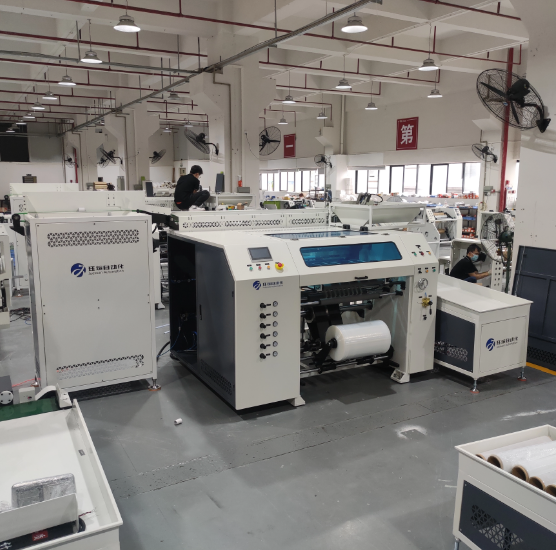
High-volume buyers demand uniformity. They need every roll on the pallet to have the same hardness, the same edge profile, and the exact footage promised. Automation removes the variability of the "human touch," which is often the source of quality complaints.
Stretch film requires precise tension management. If wound too loosely, the roll becomes soft and telescopes during shipping. If wound too tightly, the core may be crushed. On manual machines, operators often adjust tension based on "feel," leading to inconsistency between shifts.
Fully automatic systems rely on PLC-driven tension curves. They also utilize active contact rollers (lay-on rollers) that press against the winding surface to exclude air (aeration). This prevents the "spongy" feel associated with poor-quality rewinding and ensures a rock-hard, professional roll profile every time.
Two critical areas where automation saves money are length metering and edge quality:
Eliminating Giveaway: Manual operators often over-wind rolls by 2% to 5% just to "be safe" and ensure the customer gets the advertised length. This "giveaway" costs thousands of dollars in resin annually. High-speed electronic counters on automatic machines ensure every roll has the exact footage sold—no more, no less.
Edge Profile: Manual alignment often results in the "coning" effect, where the film edge is not perfectly flush. Automated slitting knives (whether razor or shear) are rigidly mounted and aligned, ensuring clean, straight edges that look premium on the shelf.
Certain niche products require even higher precision. For example, a fully automatic handle film slitting machine must insert a plastic or paper handle into the roll during the winding process. This mechanical insertion must be perfectly timed. If the handle is misaligned, it can jam the end-user's application or cause the roll to wobble. Automation ensures this insertion happens at the exact same millimeter mark on every unit, preventing jams and returns.
Moving to full automation changes the fundamental economics of your factory floor. You stop paying people to load pipes and start paying them to manage production flow.
The most immediate financial impact is the labor ratio. In a semi-automatic setup, the ratio is typically 1:1—one operator for every running machine. If the operator steps away for a break, production stops.
With fully automatic lines, the role shifts from "operator" to "supervisor." One worker can easily manage 2 to 4 machines simultaneously. Their primary tasks become monitoring the core hoppers, boxing finished goods, and overseeing quality. This reduces your reliance on highly skilled manual laborers. The machine controls the quality, not the worker's dexterity.
| Feature | Semi-Automatic Line | Fully Automatic Line |
|---|---|---|
| Labor Ratio | 1 Person : 1 Machine | 1 Person : 3-4 Machines |
| Cycle Transfer Time | 3–5 Minutes (Manual) | < 30 Seconds (Auto) |
| Skill Requirement | High (Manual dexterity required) | Moderate (Process supervision) |
| Safety Risk | High (Repetitive strain, cuts) | Low (Guarded operation) |
Manual core loading and roll doffing are prime causes of repetitive strain injuries (RSI) in converting plants. Operators performing the same heavy lifting and twisting motions hundreds of times a day face significant injury risks.
Automation mitigates this liability. Core hopper feeding and automated knife guards remove operators from dangerous cut and pinch zones. By reducing physical interaction with the machine, you lower your workers' comp claims and improve overall Environmental Health and Safety (EHS) scores.
Waste is a silent profit killer. On manual lines, the "start" (attaching the film to the core) and the "tail" (cutting the end) often result in wasted footage. Operators may crumple several meters of film just to get it to stick to the core.
Automated taping and cutting systems are precise. They use the minimum amount of film necessary to start the roll. Furthermore, the gentle handling of automated grippers reduces damage to paper cores. Manual hammering or fitting often crushes cores, rendering them useless; automation handles them with consistent pressure.
The upfront price tag of a fully automatic slitter is undeniably higher than a semi-auto unit. However, smart buyers look at the payback equation, not just the sticker price.
The Return on Investment (ROI) calculation must include three main pillars:
Labor Savings: reducing headcount or reallocating staff to high-value tasks.
Material Savings: eliminating resin giveaway and reducing startup waste.
Capacity Increase: the profit margin gained from selling 30-50% more volume per shift.
For many high-volume producers, the payback period is often under 18 months due to these combined efficiencies.
Durability also plays a role in TCO. Heavy-duty frames are required to support the high speeds and rapid indexing of automation. These frames typically last significantly longer than the lighter frames used for semi-auto units.
However, you must be transparent about maintenance. While semi-auto machines can be fixed with a wrench and a hammer, fully automatic lines require a higher level of maintenance competence. Your team will need basic knowledge of PLCs and servos (or a good service contract) to maintain peak performance.
Finally, consider the future. Fully automatic lines are the building blocks of a "dark factory" or lights-out manufacturing environment. They can integrate with downstream packaging equipment—such as auto-boxing machines and robotic palletizers. A semi-automatic machine is an island; a fully automatic machine is part of an integrated ecosystem.
Not all automatic slitters are created equal. When evaluating vendors, look past the brochure speed and scrutinize the core specifications.
First, check the slitting method. Razor slitting is standard for PE films, but shear cutting might be necessary if you process PVC or thicker laminates. Ask about the automation level. Does the quote include auto-labeling inside the core? Is there integration for auto-boxing?
Crucially, ask for the "total cycle time." Some vendors quote high mechanical speeds but have slow turret transfer times. You need to know the total time from one finished roll to the next.
There is always a trade-off between a dedicated machine and a universal one. A dedicated handle film machine will outperform a universal slitter on handle rolls, but it lacks versatility. Conversely, a universal slitter offers flexibility but might require changeovers.
Speaking of changeovers, ask: "How long to switch from a 500mm width to a 450mm width?" Tool-less changeovers are a key differentiator for modern machines, allowing you to switch products in minutes rather than hours.
Ensure the machine uses non-proprietary electronic components. If the PLC is a standard brand like Siemens, Mitsubishi, or Delta, you can source parts locally. If the electronics are proprietary to the machine builder, you are locked into their supply chain forever, which poses a risk to long-term serviceability.
The choice between semi-automatic and fully automatic equipment is ultimately determined by your production volume and growth goals. Semi-automatic machines remain a valid choice for low-volume, high-mix shops where flexibility is more valuable than velocity. However, for volume producers aiming for resin economy and labor resilience, fully automatic is the only viable path.
Investing in automation is not just about buying speed. You are buying predictability. You are securing a fixed cost per roll that does not fluctuate with operator fatigue or labor shortages. By closing the cycle gap and ensuring precision metrology, fully automatic slitting machines turn your converting floor into a consistent, high-yield profit center.
A: The main difference lies in the roll changeover process. On a semi-auto machine, an operator must manually cut the film, tape the tail, remove the finished roll, and load a new core. This causes downtime. A fully automatic machine handles all these steps (cutting, core loading, taping, and transfer) automatically without stopping the line, significantly increasing daily throughput.
A: Yes, most modern fully automatic machines are versatile. However, changing between 1-inch and 3-inch cores typically requires swapping out the air shafts and adjusting the hopper system. High-quality machines are designed with "tool-less" or quick-change features to make this switch efficient, often taking less than 30 minutes.
A: For facilities running at least two shifts per day, the payback period is typically between 12 and 18 months. This ROI is driven by labor reduction (one operator managing multiple machines) and material savings (eliminating "giveaway" footage and reducing start/tail waste).
A: Generally, no. They accept standard jumbo rolls. However, because the machine runs at higher speeds, the master roll should be wound correctly with consistent tension. Poorly wound master rolls (telescoped or soft) may cause web breaks at high speeds, which can interrupt the automated cycle.
A: It is significantly faster and more consistent. Manual handle insertion is slow and prone to errors, often limiting line speed to allow the operator to keep up. Automatic insertion allows the machine to run near full speed while mechanically placing the handle at the exact correct position every time, increasing output by over 50% compared to manual methods.


