
Views: 0 Author: Site Editor Publish Time: 2025-12-29 Origin: Site


In the competitive landscape of stretch film production, selecting the right machinery is the pivot point between profitability and operational inefficiency. A common stumbling block for facility managers and procurement officers is the confusion surrounding equipment terminology. Misunderstanding the distinction between slitting and rewinding often leads to equipment mismatches—resulting in either over-specifying for simple jobs or under-delivering on precision cuts. While both machines process film rolls, their mechanical architectures and end-products differ fundamentally.
This guide defines the scope by clarifying the technical and operational differences between a dedicated rewinding machine and a precision slitting machine. We aim to move beyond basic definitions to compare output capabilities, automation levels, and ROI potential to support your procurement decisions. By understanding the specific engineering focus of each unit, you can align your production line with your actual business objectives, whether that is high-volume logistics roll production or specialized converting.
Primary Distinction: Rewinding machines focus on changing roll diameter (jumbo to hand/machine rolls) and correcting tension; slitting machines focus on changing roll width (wide web to narrow strips) with high precision.
Automation Impact: Fully automatic systems reduce labor costs by up to ~80% and lower film waste from 5% (manual) to under 1.5%.
Component Differences: Slitters require complex differential shafts and rotary knives; rewinders prioritize surface friction rollers and simple razor cuts.
Decision Rule: Choose rewinders for volume production of standard rolls; choose slitters for custom sizing and converting operations.
When evaluating machinery, you must look at the primary objective of the equipment. While there is functional overlap, the engineering priorities differ significantly between a standard rewinder and a specialized slitter. The choice depends largely on whether your primary variable is diameter (length) or width.
The primary goal of a standard rewinder is conversion. You are taking large master rolls, often called Jumbo rolls, and breaking them down into smaller, manageable finished products. These are typically hand wrap rolls (light enough for manual application) or machine wrap rolls (standardized for automatic pallet wrappers).
The process focuses heavily on tension correction. Jumbo rolls often come from the cast line with internal stress or uneven tension profiles. A high-quality rewinder utilizes pressure rollers to eliminate air between film layers. This "ironing" effect creates a rock-hard, compact roll that saves shipping volume and prevents telescoping. The typical output retains the uniform width of the master roll—or involves very minor edge trimming—but features a significantly reduced diameter and length.
In contrast, a slitting machine is designed for geometric transformation. Its goal is to cut a wide web into multiple narrower strips simultaneously. This requires a much higher degree of lateral stability.
The process involves precise longitudinal cutting. Whether using razor banks or rotary shear blades, the machine must maintain parallel cuts across hundreds or thousands of meters of film. Following the cut, the machine employs multi-shaft winding to handle the separate strips. The typical output is multiple narrow coils—such as 50mm or 100mm banding film—produced from a single 500mm or larger master roll. This capability is essential for converting operations serving niche markets like bundling or profile wrapping.
It is important to note a functional overlap that causes confusion. Most rewinding machines possess basic slitting capabilities, specifically for edge trimming. They can slice a few centimeters off the side of a roll to clean up a rough edge. However, they lack the precision controls and shaft technology of a dedicated slitting machine required to split a web into four, five, or ten separate lanes effectively.
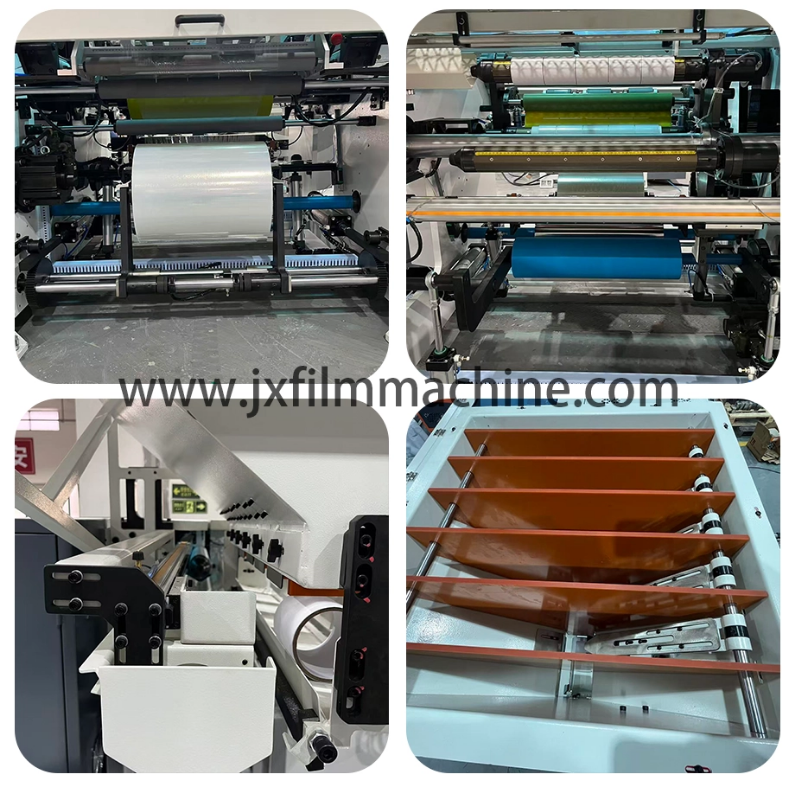
To truly understand why one machine cannot simply replace the other, we must examine the internal mechanics. The differences in cutting mechanisms, winding methodologies, and tension control systems dictate the quality of the final product.
The cutting section of a rewinder is generally built for speed and simplicity. It typically uses stationary razor blades or simple industrial blades primarily for edge trimming. The focus here is on maintaining high line speeds without web breaks. Since the web is usually kept whole, lateral movement is less critical.
Conversely, a slitter utilizes more complex setups, such as rotary cutters or adjustable razor banks. High-end slitters require exceptional rigidity. If the blade vibrates or the web weaves even a fraction of a millimeter, the resulting rolls will have "scalloped" edges, rendering them unsellable. Stability is the paramount engineering constraint here.
The method used to wind the film onto the core is perhaps the most distinct technical difference.
Surface Driven (Rewinder): Most standard rewinders use friction rollers (surface winding). The film roll rests against a driven drum. This contact drives the rotation and squeezes out air pockets. It is the ideal method for creating tight, compact rolls of standard stretch film where the width is constant.
Center Winding / Differential Shafts (Slitter): Surface winding is problematic for slitting. If you cut a web into five strips, one strip might be slightly thicker than the others due to gauge variation in the master roll. On a surface winder, the thicker roll would grow faster, taking all the contact pressure, while the looser rolls would telescope. Therefore, slitters use center winding with differential shafts. These shafts use friction rings to allow each strip to slip slightly and wind at its own required speed, ensuring uniform tension across all finished coils.
Tension management also differs in orientation. A rewinder focuses on longitudinal tension control. The system adjusts brake pressure on the unwind stand to prevent the film from stretching (necking down) or winding too loosely (telescoping/coning).
A slitter, however, must obsess over lateral stability. They often feature advanced optical guiding systems. These sensors detect the web's position and physically shift the unwind stand to align the film precisely with the knives. Without this lateral correction, narrow cuts would wander, creating inconsistent strip widths.
| Feature | Standard Rewinding Machine | Dedicated Slitting Machine |
|---|---|---|
| Primary Action | Diameter Reduction (Rewinding) | Width Reduction (Slitting) |
| Winding Type | Surface Driven (Contact) | Center Driven (Differential Shafts) |
| Blade Setup | Static Razor (Trimming) | Rotary/Bank (Multi-lane) |
| Tension Focus | Longitudinal (Stretch prevention) | Lateral (Edge alignment) |
The industry is rapidly shifting away from manual operation toward automation. Understanding the capabilities of a fully automatic rewinding machine versus its slitting counterpart helps in calculating Total Cost of Ownership (TCO).
Automation in rewinding is mature and highly efficient. These systems handle the entire lifecycle of a roll without human intervention. Capabilities include automatic core feeding via a hopper, attaching the film to the core (often without glue), cutting the film at the precise length, and ejecting the finished roll onto a conveyor.
The throughput is impressive. Modern machines achieve speeds up to 600–1000 meters per minute. More importantly, automatic changeovers—switching from a full roll to a fresh core—take less than 3 minutes equivalent cycle time, compared to over 10 minutes for manual setups. The labor impact is profound; a single operator can oversee a bank of 2–3 machines, monitoring quality rather than physically lifting heavy rolls.
Automation in slitting is more complex due to the precision required. A fully automatic slitting machine often features turret winders. As one set of shafts winds the product, the other set is offloaded and re-cored, allowing for non-stop operation. High-end models may even feature auto-positioning knives.
However, setup times are inherently longer than rewinders. Calibrating knives for a specific width and setting up the differential shafts takes time. Yet, once running, the automation maintains a width tolerance of ±0.1mm, a consistency manual operators struggle to match. The return on investment here comes from quality assurance—preventing rejected batches due to width variance.
When justifying the capital expenditure, consider these data drivers:
Waste Reduction: Manual processes rely on operator skill to minimize "tails" and start-up waste. Automated systems reduce material waste to less than 1.2%, whereas manual or semi-auto setups often average around 5% waste due to human error and manual cutting inefficiencies.
Throughput: For manufacturers producing over 5 tons per day, automated rewinders are essential to prevent bottlenecks. For slitters, the ROI is justified by high-mix order volumes where custom widths command a premium price.
Deciding between these machines should be driven by your production scenarios. Here is a framework to guide your selection.
Need: You are producing standard 500mm hand rolls or machine rolls from jumbo stock. The market demands consistency, tight rolls, and speed.
Verdict: Rewinding Machine. You need a machine that prioritizes line speed, auto-core feeding, and finished roll appearance. The ability to remove air and create a hard roll is critical for logistics. A slitter would be overkill and likely slower due to the complexity of the winding shafts.
Need: Your orders include 100mm banding film, 250mm mini-rolls, or you need to correct master rolls that have telescoped badly.
Verdict: Slitting Machine. Standard rewinders cannot produce narrow banding film effectively; the rolls will topple or wind unevenly. You need the precision of differential shafts and the lateral stability of a slitter to align edges perfectly.
Need: You want to offer pre-stretched film (reducing thickness to save money for clients) or add perforations for tear-off sheets (common in laundry or food service).
Verdict: Specialized Rewinder. Look for a rewinder equipped with pre-stretch gear ratios and perforation modules. While this is technically a rewinding process, the machine requires specific auxiliary motors to stretch the film before it is wound.
Beyond the purchase price, the operational realities of owning these machines differ. Maintenance schedules and infrastructure requirements affect your long-term Total Cost of Ownership (TCO).
Slitters generally incur higher consumables costs. You will be replacing razor blades or sharpening rotary knives frequently, especially if processing abrasive additives. Differential shafts also require maintenance; the friction rings inside them wear out and must be cleaned or replaced to ensure even tension.
Rewinders have a lower maintenance profile. The primary wear parts are rubber pressure rollers and drive belts. When selecting a rewinder, look for features like "quick-release blade holders." Even though they use fewer blades, being able to swap a dull trimming blade in seconds rather than minutes keeps your OEE (Overall Equipment Effectiveness) high.
Do not underestimate the physical footprint. Fully automatic lines require significant floor space, often exceeding 12 square meters per line, plus room for raw material staging and finished goods packing.
Infrastructure is also key. Both machines, particularly those with pneumatic shafts and automatic core feeding, require a dedicated, clean compressed air supply. Furthermore, vibration control is critical. For machines running at high speeds (500m/min+), ensure the equipment features cast iron (C.I.) body construction. A heavy frame dampens vibration, which directly correlates to the smoothness of the roll edge. A vibrating machine produces ridges on the roll side, which customers may interpret as poor quality.
Safety is non-negotiable. Fully automatic rewinding machines involve high-speed rotating parts and automated arms that move with considerable force. Safety fencing, light curtains, and auto-stop sensors are critical features. Ensure any machine you import meets local safety standards (such as CE marking in Europe) to avoid liability and ensure operator safety.
While the terms are often used interchangeably on factory floors, the equipment serves different primary business goals. A rewinding machine is a volume production tool designed to convert jumbo stock into standard shipping rolls efficiently. It excels at speed, tension correction, and diameter reduction. A slitting machine is a precision converting tool designed for geometric alteration, turning wide webs into multiple narrow products with exacting tolerances.
When making your final decision, do not base it solely on the initial purchase price. Calculate your TCO based on scrap rates—comparing the 5% waste of manual operations against the 1.5% of automated systems—and consider labor allocation. Furthermore, examine the specific tolerance requirements of your end customers; industries like electronic packaging often demand the precision of a slitter, whereas general logistics markets prioritize the cost-efficiency delivered by a high-speed rewinder.
A: Generally, no. While most rewinding machines have blades for trimming the edges of a roll, they lack the differential shafts and lateral guiding systems required to cut a wide web into multiple narrow strips effectively. Using a rewinder for multi-lane slitting usually results in poor tension control and uneven roll edges.
A: Rewinding machines are typically faster, often reaching speeds of 1000m/min because the winding process is simpler (surface driven). Slitting machines usually operate at slightly lower speeds (often 400-600m/min) because the multi-lane cutting and differential winding process requires more stability and precision.
A: A differential shaft allows independent tension for each strip of film being wound. Since plastic film varies slightly in thickness across the web, "thicker" strips wind faster than "thinner" ones. Without a differential shaft (which allows slippage), the tight rolls would snap or the loose rolls would telescope.
A: Fully automatic machines are designed to minimize waste significantly. You can expect waste rates to drop to approximately 1.2% to 1.5%. This is a major improvement over manual or semi-auto machines, which often generate 5% waste due to manual cutting errors and long "tails" left on the core.
A: While designed for PE stretch film, high-quality slitters and rewinders can often handle PVC cling film, barrier films, and sometimes aluminum foil, provided the tension systems and cutting blades are adjusted. However, PVC usually requires specific machine coatings to prevent corrosion and sticking.


