
Views: 0 Author: Site Editor Publish Time: 2026-02-04 Origin: Site


In the industrial packaging sector, the difference between breaking even and maximizing profit often comes down to one metric: efficiency. If your production line relies on manual operator intervention for every roll change, you are likely losing valuable minutes that add up to hours of lost productivity every week. This is where a fully automatic stretch film slitter rewinder transforms operations.
These machines are the workhorses of the film converting industry. They take massive master rolls (jumbo rolls) and convert them into market-ready hand rolls or machine rolls with speed and precision. However, not all machinery is created equal. Understanding the technical specifications—from shaft configurations to cycle times—is essential for making an informed capital investment. This guide breaks down the critical specs and features you need to look for when selecting a high-performance film rewinding and slitting machine.
Before diving into the numbers, it is helpful to understand the core functionality. A fully automatic unit handles the entire converting lifecycle without human assistance. It automatically loads paper cores, winds the film to a precise length, cuts the film, and ejects the finished product.
The primary advantage here is consistency. A stretch film rewinder and slitter equipped with servo motors ensures that the tension remains constant throughout the winding process, preventing telescoping (where the film slides out the side) and ensuring a flat, professional edge.
When reviewing data sheets from manufacturers like Juexuan Automation, specific metrics indicate the machine's capability. Below are the primary specifications you should prioritize.
Manufacturers often list a "mechanical design speed," which is the theoretical maximum. However, you need to look for the "production speed" or "real process speed."
Standard Efficiency: 400–500 meters/minute.
High Efficiency: 600–800 meters/minute.
For example, high-speed models often utilize a four-shaft exchange system to maintain speeds of up to 600m/min during the rewinding process. Higher speeds require robust frame construction to minimize vibration, which can affect the quality of the rewind.
The number of shafts determines how quickly the machine can cycle between finished rolls and new cores.
Configuration | Description | Best For |
|---|---|---|
2-Shaft | Basic automatic turret. One shaft winds while the operator or machine preps the other. | Low to medium volume production. |
4-Shaft | Continuous operation. Two shafts wind while two are ejecting/loading. | High-volume manufacturing. Significantly reduces cycle time gaps. |
A fully automatic 4-shaft turret winder allows for non-stop operation, drastically increasing daily output.
If you are producing hand wrap, you likely need a machine capable of slitting a 500mm master roll into smaller widths or rewinding it as is.
Effective Width: Typically 300mm to 700mm.
Slitting Options: Look for machines that offer Modular slitting unit. This allows you to produce various finished widths (e.g., converting a 500mm roll into two 250mm rolls) on the same film rewinding and slitting machine.
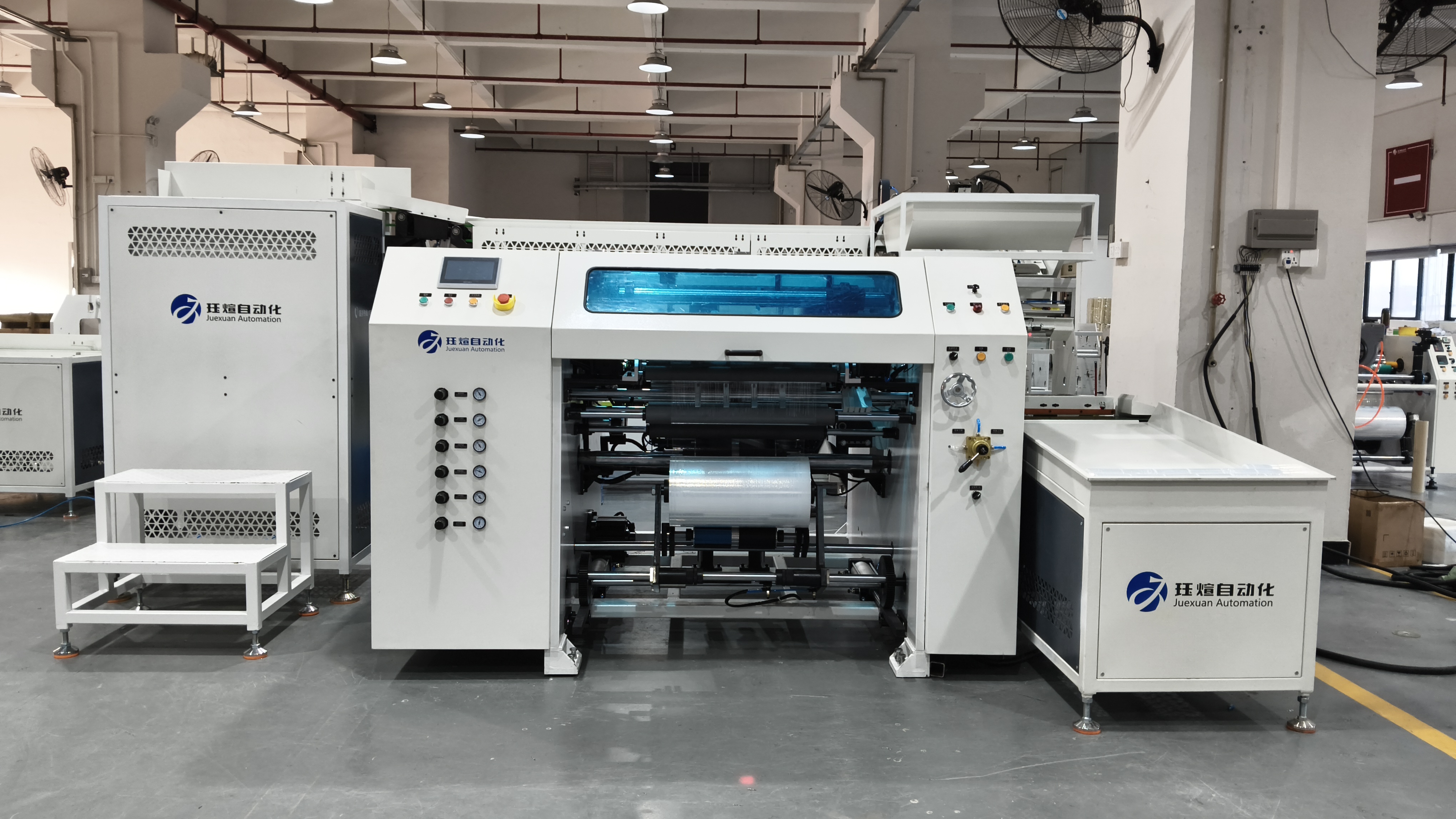
Beyond the raw speed and width, the "brain" of the machine dictates its reliability. When evaluating a stretch film rewinder and slitter, look for these control system features:
A Programmable Logic Controller (PLC) acts as the machine's central computer. It should be paired with a Human-Machine Interface (HMI)—a touch screen that allows operators to input parameters easily.
Recipe Storage: Can the machine remember settings for "500m Hand Roll" vs. "1500m Machine Roll"?
Fault Diagnostics: Does the screen tell you exactly where a sensor failed, or do you have to guess?
Older machines used simple AC motors and clutches. Modern high-speed units use servo motors for the traction rollers and winding shafts. Servo drives provide precise control over acceleration and deceleration, which is critical when handling thin, stretchy films that snap easily under sudden tension changes.
True full automation means the operator only needs to replenish the master roll and the hopper of paper cores.
Auto-Core Loading: A magazine feeds cores onto the shafts automatically.
Conveyor Off-loading: Finished rolls are gently pushed onto a conveyor belt, ready for boxing or palletizing.
1
The specifications on paper are only as good as the build quality of the machine. When choosing a supplier, look for those with a proven track record in the specific niche of stretch film machinery.
Companies like Juexuan Automation focus heavily on R&D for this specific vertical. Their utilization of CNC machining for parts ensures high precision, reducing vibration and wear over time. Additionally, verify that the manufacturer holds relevant certifications like CE or TUV, which guarantee the equipment meets international safety and operational standards.
Investing in a fully automatic stretch film slitter rewinder is a strategic move to lower labor costs and increase throughput. By paying close attention to the shaft configuration, production speeds, and the integration of servo drive systems, you ensure that your facility is equipped to handle high-volume orders with ease.
Whether you opt for a versatile slitter that can handle multiple material types or a specialized coreless rewinder to meet sustainability goals, the right technical specs will serve as the foundation for your plant's efficiency.


